Light sources known as free-electron lasers can produce intense X-ray radiation for a wide range of applications. The process usually needs huge particle accelerators, but an experiment shows how to overcome this limitation.
The advent of new tools for investigating our world has always led to discoveries. Light sources called free-electron lasers (FELs) are examples of such tools. FELs can produce radiation in a broad array of wavelengths, including the extreme-ultraviolet1 and X-ray2 ranges, and can generate ultrashort pulses, at femtosecond3 (10–15 s) or even attosecond4 (10–18 s) timescales. At these spatial and temporal scales, there is little difference between biology, chemistry and physics, and FELs have revolutionized all three disciplines. FELs have enabled matter to be frozen in place and observed at the microscopic level, allowing scientists to resolve the motion of atoms or electrons, control chemical reactions and follow the dynamics of chemical bonds or energy-transfer processes. In a paper in Nature, Wang et al.5 report a milestone in the development of compact X-ray FELs.
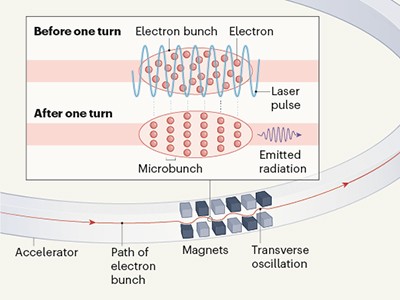
FELs generate radiation from a high-energy electron beam traversing an undulator, a long array of magnets of alternating polarity (Fig. 1). The undulator causes the electrons to oscillate transversely, and the oscillating beam emits light at a wavelength proportional to the spatial period of the oscillation divided by the square of the beam energy. Therefore, the beam energy is one of the main parameters used to tune the output wavelength of the FEL light.

Figure 1 | A free-electron laser driven by electrons accelerated in a laser-excited plasma wave. Wang et al.5 fired a laser pulse at a gas jet to produce an ionized gas called a plasma. Electrons in the plasma were accelerated as they ‘surfed’ an electromagnetic wave known as a plasma wave. The authors directed the resulting high-energy electron beam into a light source called a free-electron laser, which comprises an array of magnets of alternating polarity (indicated by the two shades of grey). These magnets caused the beam to oscillate transversely and emit radiation. Initially, the electrons were randomly distributed and generated low-amplitude light. However, when leaving the magnets, the electrons were bunched into regions about the size of the radiation wavelength and emitted high-amplitude light. This demonstration shows that high-energy electron beams for free-electron lasers can be produced in compact set-ups (Wang and colleagues’ set-up was about 12 metres long), rather than requiring particle accelerators several hundred metres to a few kilometres in length.
Energy is efficiently transferred from the electron beam to the laser light if the beam has a high-enough current and is sufficiently monochromatic — that is, if the electrons have similar energies, follow similar trajectories and emit light with similar properties. When such a high-brightness beam interacts with the electromagnetic field of the light generated inside the undulator, the beam transfers part of its kinetic energy to the laser light. As a result, the light is amplified by several orders of magnitude while propagating through the undulator. FELs therefore require high-energy and high-brightness electron beams to generate intense laser light at short wavelengths, such as extreme-ultraviolet or X-ray wavelengths.
Electron beams are normally accelerated by injecting the electrons into a long sequence of hollow metal structures called resonant cavities, where the particles progressively gain energy by ‘surfing’ an electromagnetic wave. The final energy depends on the amplitude of the wave (that is, the strength of the accelerating field) and the length of the accelerator. Present technology limits the field strength in accelerating cavities to a few tens of megavolts per metre. Therefore, an accelerator several hundred metres to a few kilometres in length is required to reach the beam energy of several gigaelectronvolts (GeV) needed by an X-ray FEL. High-energy electron beams therefore tend to be available only at large accelerator facilities, limiting the number of scientists who can access FELs or advanced investigation tools needing high-energy electrons.
This restriction is one of the motivations behind the search for alternative ways of producing strong accelerating fields to reduce the footprint and costs associated with accelerators. One promising idea involves exciting an electromagnetic wave in a plasma — an ionized gas — using the high power density of optical lasers6. Accelerating fields that are thousands of times stronger than those in conventional accelerating cavities can be generated in a plasma. With such fields, the electron-beam energy required by an X-ray FEL could be reached in a few tens of centimetres instead of a few kilometres.
A plasma wave can be excited by a laser pulse or the electron beam itself. Indeed, it is possible to shape the beam current in such a way that one part of the beam excites the wave, which then accelerates a second part of the same beam. Both approaches were explored previously, and enormous field strengths, similar to those predicted6, were demonstrated7,8. But one of the missing ingredients to drive FELs successfully using these beams concerned the beam quality. Specifically, the energy difference between the electrons was too large, and the emitted radiation behaved as though generated by randomly distributed electrons, rather than by electrons bunched into regions about the size of the radiation wavelength, for which the light amplification is several orders of magnitude larger.
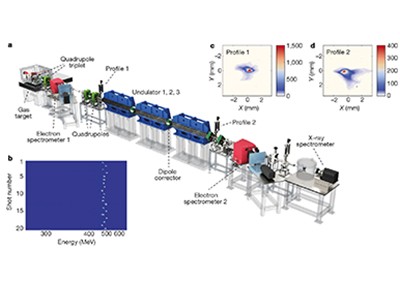
Various teams are concentrating on finding the conditions for stable and reliable acceleration of an electron beam that is sufficiently monochromatic for FEL amplification9. Wang et al. have demonstrated, for the first time, that this amplification can be achieved using electrons accelerated in a laser-excited plasma wave (Fig. 1). The authors produced the plasma wave by firing a laser pulse at a gas jet that had a diameter of only 6 mm. By manipulating the density of the gas, they shaped the plasma density along the acceleration direction and loaded electrons from the plasma into the accelerating phase of the plasma wave. This technique ensured that the generated beam, with an energy of about 0.5 GeV, was of sufficient quality to amplify radiation in an extreme-ultraviolet FEL at an output wavelength of 27 nm.
The performance of Wang and colleagues’ FEL cannot yet match that available in existing FEL facilities that produce radiation at similar wavelengths1,10. However, this laser represents a technological breakthrough, and its stability, reproducibility and efficiency in transferring energy from the electron beam to the radiation will probably be improved in the future. The authors’ experiment paves the way for FELs driven by extremely compact accelerators11, which could be managed in university-scale facilities. One of the requirements for a new tool that will favour discoveries is its availability, and this work promises to increase the availability of FEL light in the world.


0 Comments